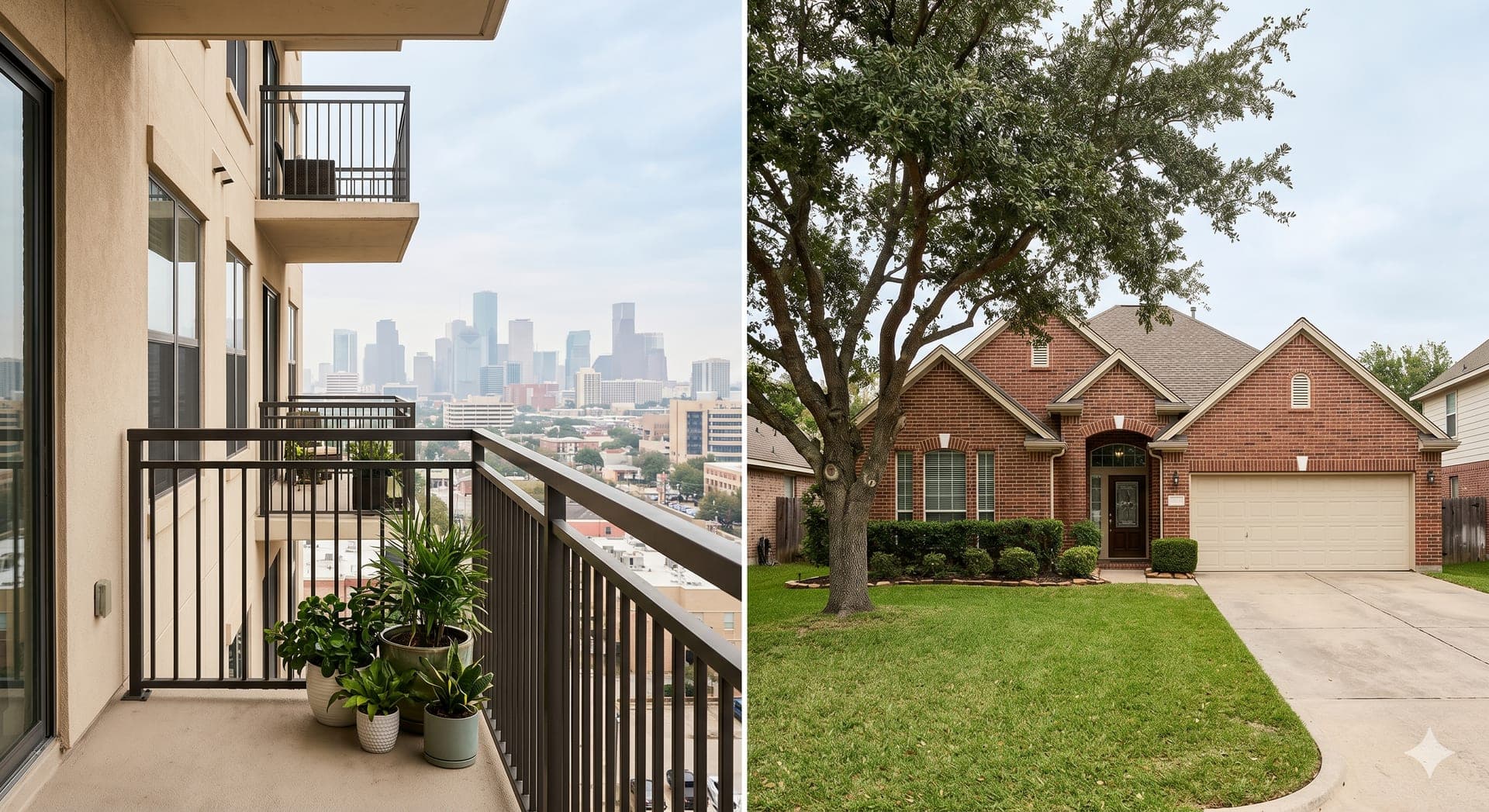
I get this question more than almost any other: "Should I keep renting or should I buy?"
And my honest answer is always the same. It depends. I know that's not the exciting, definitive answer people want, but I'm not going to tell you to buy a house just because I'm a real estate agent. That's not me. If buying doesn't make sense for your situation right now, I'll tell you that. I'd rather you wait six months and make the right move than rush into something because someone on the internet told you renting is "throwing money away."
That said, let's actually look at the numbers. Because for a lot of people in Houston right now, buying makes more sense than they think.
What Renting in Houston Actually Costs Right Now
Average rent in the Houston metro for a two-bedroom apartment is hovering around $1,400 to $1,700 a month, depending on the area. In the suburbs south of Houston (Pearland, League City, Friendswood) you're looking at $1,500 to $1,900 for something decent.
That's just rent. Add in renter's insurance (usually $15 to $30 a month) and any pet deposits or fees, and you're looking at a baseline monthly cost with zero equity to show for it.
And here's the part that frustrates me on behalf of renters: your rent goes up. Almost every year. You have very little control over that. Your landlord decides to raise it $100 a month and your options are pay it or move. Neither one is free.
When my partner and I first moved to Houston, we rented an apartment for about a year and a half. At the time, it made sense. We didn't know the area, his job location wasn't fully pinned down, and we needed to figure out where we wanted to actually live. Renting gave us that breathing room. But once we knew? We bought. Because the math just made more sense.
What Buying in Houston Actually Costs Right Now
Let's use a real example. Say you're looking at a $300,000 home in Pearland. A solid, updated three-bedroom in a good neighborhood. Here's what that looks like with today's numbers.
With a conventional loan at 3% down, your down payment is $9,000. At a 6.5% interest rate (roughly where rates are sitting as I write this), your principal and interest payment comes out to around $1,840 a month.
But that's not your whole payment. You have to add property taxes (let's say 2.3%, so about $575/month), homeowners insurance (roughly $250/month), PMI since you're under 20% down (around $150/month), and possibly flood insurance depending on the zone.
All in, you're looking at somewhere around $2,800 to $3,100 a month for that $300,000 home.
I'm not going to sugarcoat that. It's more than rent. For most people, the monthly payment on a purchased home is going to be higher than what they're paying in rent. Anyone who tells you otherwise is either doing fuzzy math or selling you something.
So Why Would You Buy If It Costs More Per Month?
Because the monthly payment isn't the whole story. Not even close.
You're building equity. Every month, a portion of that payment goes toward paying down the principal on your loan. That's money you get back when you sell. Rent? That's gone. Every single dollar.
Your rate is locked. If you get a fixed-rate mortgage at 6.5%, that's your rate for 30 years. Your principal and interest payment never changes. Meanwhile, your rent will almost certainly go up every single year. Five years from now, that $1,600 rent could be $2,000. Your mortgage? Same number it was on day one.
Houston home prices have gone up over time, even with the dips. The market bounces around. And right now prices are actually down a bit from the peak, which is good for buyers. But zoom out five, ten, twenty years and the trend is up. You're buying something that tends to be worth more later. Your apartment isn't doing that for you.
Tax benefits. Mortgage interest and property taxes are tax-deductible. I'm not a tax advisor, so talk to yours, but for a lot of first-time buyers this makes a meaningful difference come April.
The Break-Even Point: When Buying Starts Winning
Here's where the math gets interesting. In most scenarios in Houston, if you stay in the home for three to five years, buying overtakes renting, even with the higher monthly payment.
That's because of the equity you've built, the appreciation on the home's value, and the tax savings. Run the numbers for yourself, but in a typical Houston scenario at current prices and rates, year three or four is usually where you cross the line and start coming out ahead compared to renting.
If you're planning to stay in Houston for less than two or three years, renting probably makes more sense. Moving costs, closing costs, and the early years of a mortgage being interest-heavy mean you might not recoup enough. That's real, and I'll tell you that upfront.
But if you're putting down roots? If Houston is home or becoming home? The sooner you buy, the sooner the math starts working for you.
"But I Don't Have 20% for a Down Payment"
I wrote a whole post about this, but let me say it again because it stops so many people: you do not need 20% down to buy a house.
Conventional loans go as low as 3% down. FHA loans are 3.5%. VA loans are 0% if you're a veteran. USDA loans are 0% in certain areas south of Houston. Texas also has multiple down payment assistance programs that can help with your upfront costs.
On a $300,000 home, 3% down is $9,000. That's not nothing, but it's a long way from the $60,000 that 20% would require. Don't let that myth keep you on the sidelines.
"But Interest Rates Are Too High Right Now"
I hear this constantly. And I get it. Rates in the 6% to 7% range feel high compared to the 3% rates from a few years ago. But let me give you some perspective.
Those 3% rates were historically unusual. They were a pandemic response. The long-term average for mortgage rates in the US is actually around 7%. So where we are right now is normal. It just doesn't feel normal because we all got spoiled for a couple of years.
Here's what I tell my clients: you marry the house, you date the rate. Buy at a price you can afford at today's rate. If rates come down in a year or two, you refinance. You still have the house, you've been building equity the whole time, and now your payment just got lower.
What you can't do is go back in time and buy at today's prices once the market shifts. Houston has a lot of inventory right now. Prices are lower than they were two years ago. Buyers have negotiating power. That window doesn't stay open forever.
When Renting Is the Smarter Move
I want to be straight with you. Buying isn't always the answer. Here are situations where I'd tell you to keep renting:
You just moved to Houston and you're still figuring out the area. I did the same thing. Give yourself six months to a year to learn the neighborhoods, understand your commute, and figure out where you actually want to live. Buying in the wrong neighborhood because you rushed is way more expensive than another year of rent.
You're not financially stable yet. If your job situation is uncertain, your credit needs work, or you don't have an emergency fund beyond your down payment, it's okay to wait. Talk to a lender. They can tell you exactly what you need to do and give you a timeline. I tell people to talk to a lender a full year before they want to buy. They'll set you up for success.
You're staying less than two to three years. The transaction costs of buying and selling eat into your returns. If you know you're leaving, rent and invest the difference.
My Take on the Houston Market Right Now
The market is messy and complicated. I'm not going to dress it up. But here's the reality: Houston has more inventory than it's had in years, prices have come down from the peak, and sellers are negotiating. For buyers, this is a good position to be in.
Rates aren't where anyone wishes they were. But they're manageable, especially with the loan programs available. And if you wait for the "perfect" rate, you'll be waiting forever. What we're looking at right now is actually pretty close to that.
What It Comes Down To
Renting makes sense for some people. Buying makes sense for others. Anyone who gives you a blanket answer without looking at your actual numbers is full of it.
What I can tell you is this: if you're in Houston, you're employed, you've got decent credit, and you're planning to stay for a few years, you should at least run the numbers. You might be closer to buying than you think.
Get pre-approved first. Know your numbers before you start falling in love with houses. That's always my advice, no matter what.
If you want to run the numbers for your specific situation, I'm happy to help you figure it out.